
A short-video hook has two layers: the first line the viewer hears, and the text they read before that line lands. Our AI writes the second layer to a tight spec: 4 to 5 words, 30 characters at most, shown for the first 3 seconds. Across the 1,749 hook titles it has written for clips still in our system, the median is 4 words and 24 characters. Only 5.2% of them are phrased as a question.
Disclosure: ScaleReach makes an AI hook generator, so weigh the bias. Every ScaleReach figure below comes from a read-only query of our production database on 1 October 2026, covering 4,843 clips from 770 videos. The platform guidance is quoted from TikTok’s and YouTube’s own help pages, read the same day. One thing this post does not claim: that any hook formula is proven to win. Nobody publishes controlled data on that, and we don’t have it either.
The short answer
The spoken hook is a cut, not a line you write. Start the clip on the sentence that carries the payoff, not on the setup before it.
Add on-screen text only to frame that line. Keep it to about 4 words and under 30 characters, and show it for the first 3 seconds.
Name the stakes, not the topic. “The Startup Valuation Trap” beats “Startup Valuations”. A statement is the default. A question works only when the clip answers it fast.
Bottom line: in a clip cut from a long video, the easiest hook to fix is one that starts a few seconds too early. Fix where it starts before you rewrite anything.
What is a hook in a short video?
A hook is everything a viewer takes in before deciding whether to keep watching: the first spoken line, the first frame, and any text on screen. On a short-form feed that decision happens in a second or two. The viewer isn’t choosing whether to watch your video. They’re choosing whether to stop swiping.
That’s why hook advice written for long YouTube videos (“tease what’s coming later”) transfers badly. A 45-second clip has no “later”. The hook and the payoff are usually the same moment, which is why picking the right start point matters more than any line you add.
Why do the first 3 seconds decide a short?
Because the platforms measure the swipe directly. YouTube Studio reports two Shorts metrics for exactly this. Shown in feed is “the number of times that your Shorts showed in the Shorts Feed”. How many chose to view is “the percentage of times that viewers viewed your Shorts versus swiped away” (YouTube Help, verified 1 October 2026). Together they measure how well a Short’s opening stopped people mid-scroll.
TikTok’s own creative guidance says the same thing in timing terms. Its creative best practices page advises: “Introduce your content proposition in the first 3 seconds” and “Prioritize your hook in the first 6 seconds.” The same page recommends “displaying 5-10 words per second when using text.” That guidance is written for ads, not organic posts, but the feed and the viewer’s thumb are the same.
For reading the retention curve that follows the hook, see what makes a Shorts retention graph good or bad.
How do you write the spoken hook?
You choose it rather than write it. In a clip cut from a podcast, interview or talk, the hook is whichever sentence the clip opens on. Moving the start point by a few seconds changes the hook completely.
Our AI writes an edit suggestion for every clip it scores below 96. Here are two real ones from clips in our own workspace, cut from public YouTube videos:
- “Start exactly on the phrase ‘Don’t spend three weeks agonizing over something you can undo in three minutes’ at 1:43 to hook scrollers even faster than leading with ‘for reversible decisions’.”
- “Cut the intro phrase ‘make your boss’s life easier’ and open directly on ‘Here’s a lesson from every workplace ever: bosses divide employees into two categories’ at 10:14.”
Both are the same fix: the clip started on the lead-in instead of the line. Across all 1,415 suggestions the AI has written since we added the field on 16 August 2026:
| What the suggestion mentions | Share of suggestions |
|---|---|
| The word “cut” | 41.1% |
| The ending of the clip | 14.8% |
| Starting the clip at a different line | 12.5% |
| The opening, first line or first seconds | 9.6% |
Source: ScaleReach production data, 1 October 2026. These are keyword counts on free-text suggestions, so one suggestion can match several rows. Clips scoring 96 or above get no suggestion by design.
Two things stand out. Most fixes are cuts, not additions: trim the filler, the pause or the throat-clearing. And endings come up about as often as openings, because a clip that trails past its payoff loses people too. A practical rule follows:
- Find the payoff sentence first. The punchline, the number, the contrarian claim.
- Start on it, or one sentence before it at most. If the clip needs no setup to make sense, give it none.
- End right after it. Cut the “yeah, so anyway” that follows.
How do you write an on-screen hook title?
Short, specific, and about the stakes. When the spoken opening needs context, a few words of text in the first 3 seconds tell the scroller what they’re about to get before the audio registers. Our AI writes these “intro titles” to a fixed spec: 4 to 5 words, 30 characters at most, no emojis, burned in for the first 3 seconds. Here is what it actually produces:
| Measure | Result across 1,749 hook titles |
|---|---|
| Median length | 4 words, 24 characters |
| 30 characters or fewer | 93.7% |
| 5 words or fewer | 94.3% |
| Contains a number | 13.2% |
| Starts with a question word (why, how, what…) | 10.7% |
| Ends with ”!“ | 8.6% |
| Ends with ”?“ | 5.2% |
| Contains “you” or “your” | 5.0% |
| Most common first word | ”The” (205 titles, 11.7%) |
Source: ScaleReach production data, 1 October 2026. Note that about 6% of titles break the 30-character rule, so the AI doesn’t follow its own spec every time.
After “The”, the most common first words are “AI” (71), “Why” (68), “How” (57) and “This” (33). The pattern in practice is a noun phrase that names a specific stake. These are real titles from one podcast episode in our workspace:
- The Startup Valuation Trap
- Why Rich Kids Hide Their Wealth
- The 91st Day Rule
- Self-Made vs Privileged
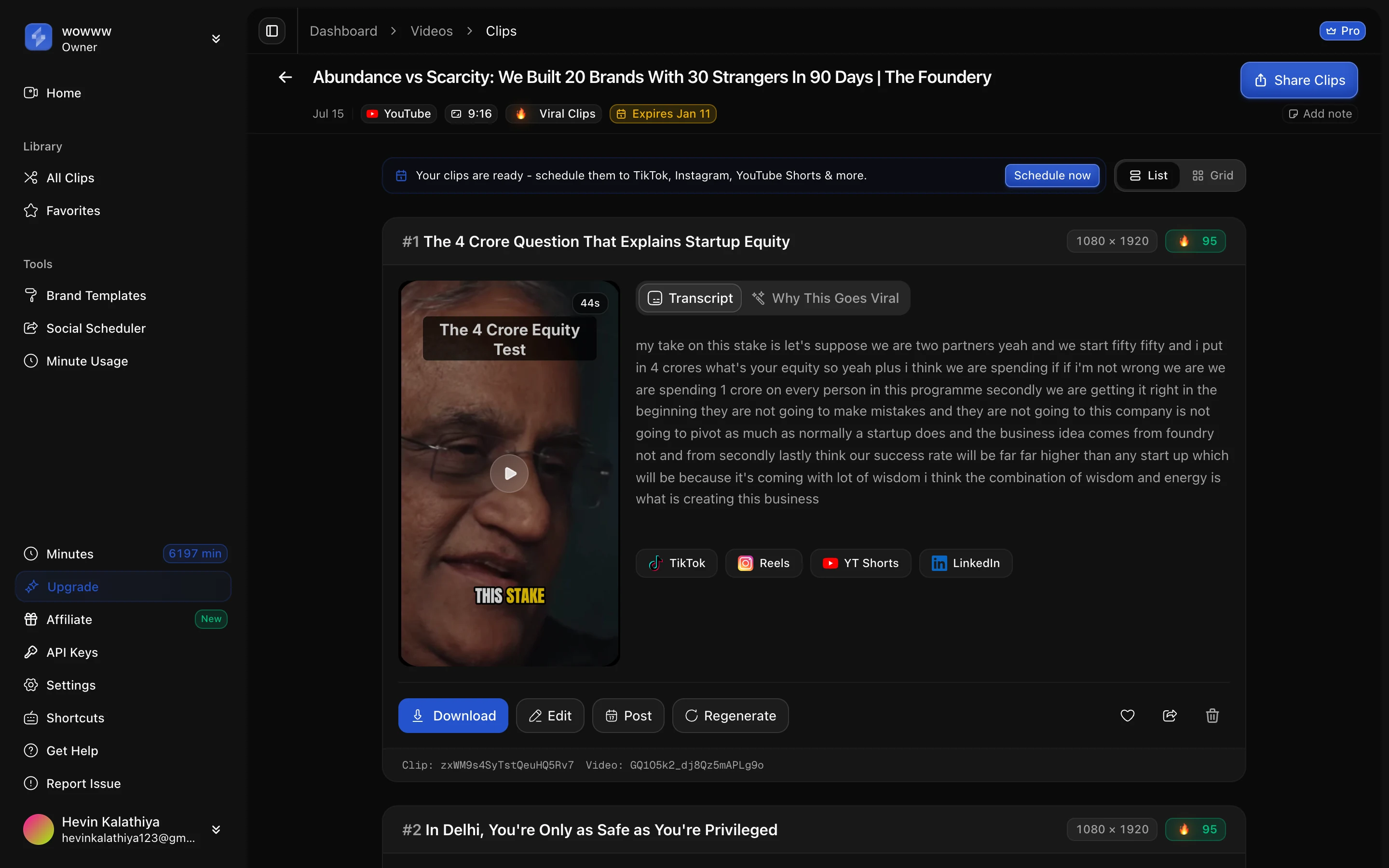
The screenshot shows when on-screen text earns its place. The spoken line opens on setup, so the title does the hooking. When a clip already opens on its strongest sentence, the title is optional, and repeating the spoken line in text adds nothing.
As for how often our users switch the title on: 1,749 of 4,843 live clips carry one (36.1%), and the setting is on for 519 of 1,947 videos (26.7%). That share moves as old clips expire from storage. On 19 September it was 55.8%.
What kinds of hooks does AI find in long videos?
Surprise, numbers and contrarian claims, roughly in that order. For every clip, our AI also writes a short label for each hook technique it detects. 82.3% of clips get two or more, and the median is two. Grouping those labels by keyword gives this picture:
| Hook type (keyword match) | Share of 4,843 clips |
|---|---|
| Shock, surprise, reveal or twist | 20.6% |
| A number, statistic or money | 12.1% |
| Contrarian or controversial claim | 8.8% |
| Relatable situation | 6.5% |
| Humor | 6.0% |
| Practical advice or a lesson | 5.4% |
| A story or personal anecdote | 5.1% |
| A direct question | 4.0% |
Source: ScaleReach production data, 1 October 2026. The labels are free text, and many quote the clip’s own dialogue, so a clip can match several rows or none. The exact labels the AI repeats most are “bold contrarian claim” (47 clips), “curiosity gap” (32), “high-stakes challenge setup” (21) and “shocking statistic” (19).
Read this table as what the AI notices in long-form speech, not what performs. It tells you where to look when you scrub an episode for a starting line: the moment someone says something surprising, puts a number on something, or disagrees with the obvious answer.
Six hook formulas, with examples
Each of these maps to a hook type above. The bracketed parts are where your own clip’s specifics go.
| Formula | Example | When it fits |
|---|---|---|
| The contrarian claim | ”[Common advice] is wrong, and here’s why” | The speaker disagrees with something the audience believes |
| The number | ”[Specific number] [unit] in [timeframe]“ | A concrete figure is the payoff |
| The named trap | ”The [topic] trap” / “The [number] rule” | The clip explains one mistake or one principle |
| The reveal | ”Why [surprising behaviour] happens” | The clip explains something unexpected |
| The stakes | ”[Person] bet [amount] on [thing]“ | Something real is on the line |
| The question | ”What is [thing], really?” | Only when the answer comes within seconds |
Use them for the on-screen title, not the spoken line. The spoken hook should be whatever your speaker actually said at the strongest moment. Rewording a guest’s line into a formula usually makes it worse.
Common hook mistakes
- Starting on the windup. “So, I think, basically…” is the most common hook problem in clipped speech, and the fix is a later start point.
- A title that repeats the first spoken line. It spends the viewer’s first seconds reading what they’re about to hear.
- A title that’s too long to read. Past about 5 words or 30 characters it stops fitting on two lines, which is why our spec caps it there.
- Promising what the clip doesn’t deliver. If the title says “the #1 mistake” and the clip never names it, viewers swipe at the moment of disappointment.
- A question the clip answers late. A question hook opens a loop. If the answer arrives at 40 seconds, most viewers leave first.
Captions carry the rest of the opening. Style and placement are covered in how to add captions that increase watch time.
Can an AI hook generator tell you which hook will work?
No, and be wary of any tool that implies it can. An AI hook generator is good at three jobs: finding the strongest line in a long recording, starting the clip on it, and writing a short title to frame it. It can’t know in advance how your audience will react.
Our own scores show the limit. Across the 7,101 clips we measured in July 2026, 82% scored 80 or above. A score that bunches that tightly is useful for deciding which clip to review first, and close to useless as a verdict on whether a hook will land. We dug into this for scoring tools in general in how accurate virality scores really are.
Use the AI to get a clip that starts in the right place, then judge the first 3 seconds yourself. Your Shorts analytics will tell you within days whether the opening stopped people.
FAQ
How do you write a hook for a short video?
Start the clip on its strongest sentence instead of the setup before it, then add a short on-screen title only if that sentence needs context. In clips cut from long recordings, the usual fix is a cut rather than new words. 41.1% of our AI’s 1,415 edit suggestions use the word “cut”, and 12.5% tell you to start the clip at a different line.
How long should a hook be?
The spoken hook is the first one to three seconds of the clip. An on-screen hook title should be about 4 words and under 30 characters. That’s the median of the 1,749 hook titles our AI has written, and 93.7% stay within 30 characters. TikTok’s own creative guidance says to introduce your content proposition in the first 3 seconds.
What makes a good hook for TikTok, Reels and Shorts?
A specific stake stated plainly: a surprising fact, a number, a contrarian claim, or a named mistake. In our data the most common hook types the AI detects are surprise or reveal (20.6% of clips), numbers or money (12.1%) and contrarian claims (8.8%). Those show what appears in long-form speech, not proof of what performs, so test on your own audience.
Should a hook be a question?
Usually not. Only 5.2% of the 1,749 hook titles our AI wrote end with a question mark, and 10.7% start with a question word. A question opens a loop that the clip has to close quickly. If the answer arrives late, viewers leave before it. Use a question only when the clip answers it within seconds. Otherwise state the stakes directly.
Do I need text on screen for a hook?
Not always. Add a hook title when the spoken opening needs context, for example when the speaker starts on setup. Skip it when the first sentence already lands. On ScaleReach, 36.1% of live clips carry an AI hook title in their first 3 seconds. Never let the title repeat the first spoken line word for word.
Can AI write hooks for short videos?
Yes, for finding and framing them. ScaleReach’s AI picks where each clip starts, writes a 4 to 5 word hook title for the first 3 seconds, labels the hook techniques it detects and suggests one edit per clip. What AI can’t do is predict which hook your audience will respond to. 82% of our scored clips land at 80 or above, which makes the score a sort order rather than a forecast.
The bottom line
A hook isn’t a clever line you bolt onto a clip. It’s mostly a decision about where the clip starts. Find the payoff sentence, start on it, end right after it, and you’ve done most of the work.
On-screen text is the second layer. Use about 4 words that name a specific stake, show them for the first 3 seconds, and only when the spoken opening needs help. Then let the viewed-versus-swiped-away number in your analytics tell you whether it worked, because no score can tell you in advance, ours included.
Every ScaleReach number here comes from our production database and is dated where it’s cited. If one looks wrong, tell us at hevin@scalereach.ai and we will correct it in the open.
Changelog
October 2026 update. First published. Hook-title, hook-label and edit-suggestion figures were measured from ScaleReach’s production database on 1 October 2026, across 4,843 live clips from 770 videos. Hook-type shares are keyword counts on free-text AI labels. The 82% score figure is from our 27 July 2026 pipeline measurement of 7,101 clips. TikTok and YouTube guidance was read from their own help pages on 1 October 2026.
Last reviewed: October 2026 Next planned refresh: January 2027 Update hooks: whether the hook-title spec changes from 4 to 5 words and 30 characters; whether the share of clips with a hook title moves off 36.1%; whether TikTok or YouTube change their published guidance on the first seconds of a video.
About the author
Hevin K runs ScaleReach, an AI clip maker that turns long videos into captioned vertical clips, each starting on the strongest line it can find and framed with a short hook title. The figures in this post come from ScaleReach’s own production database, dated where they are cited.
