
Why it works
Rock Paper Scissors is played by everyone daily. Giving two immediately testable psychological tricks (the panic 'scissors' throw and the 'see what won, beat that one' rule) makes viewers save and share the video to try on their friends.
Transcript
editing this out. You might have noticed I have yet to lose at rock, paper, scissors. That's for one of two reasons. The first is if you challenge your opponent and don't give them much time to think. to play rock paper scissors. Rock. Then you say rock paper scissors shoot, you will almost always throw scissors. Maybe because scissors is the last thing they heard and they panic. I don't know, but I swear this works like 90% of the time. That really works. The second reason is for a less surprised opponent in a best of three situation. Because the data shows winner stay and loser switch to the next in line between rock paper and scissors. So to exploit that tendency, all you need to remember is see what won then beat that one regardless of who lost. So for example, if you play paper and they throw rock, you see what one and beat that one. So your next throw should be scissors to beat your previous paper. Now let's say in a different game, you throw paper and they throw scissors. So if you see what one and beat that one, you should throw a rock to beat the previous scissors they just won with. Of course this won't guarantee a victory, but in a best of 20 you will statistically win 75% of the time.
Why it works
Packed with 4 elite, data-backed Monopoly tips (the 3-house ROI curve, creating a bank housing shortage by never upgrading to hotels, why Oranges are mathematically best after Jail, and early vs. late Jail strategy). Insanely high save-to-view ratio.
Transcript
All right, teach me all your tricks. The trick is getting three houses is the best return on your investment. Turns out Mr. Malloy had some S-tier Monopoly strategies that we totally missed in our research, and it was like I was right back in his classroom. Build the three houses fast. $16 whole dollars, please. Because three houses gives the biggest jump in rent for what you spend. 550 550 Additionally, every house you put down is one fewer in the bank's supply. So, buying them up keeps your opponents from developing. This is why world championship Monopoly games rarely end with hotels on the board. Next, go for the oranges. Jail is the most landed on square and the oranges sit six, eight, and nine spaces past it right around the most common roll. They're also cheaper to build on so you can get the three houses faster. And when it comes to jail, pay to get out early in the game so you can keep grabbing properties, but stay in late to avoid paying rent while still collecting it because that's actually what the rules allow for. And finally, Monopoly is the property trading game. It's right there in the name. So, don't be the table bully because it's impossible to win if no one wants to trade with you. So, for Monopoly, here's what to remember. One, get to three houses fast. That's where the rent jumps and you create a housing shortage. Two, buy orange because thanks to jail, they're the most frequently landed on properties. Three, if you go to jail, get out early in the game, but stay in late in the game. And four, trading is the only way to win. And eventually, no one wants to trade with the bully.
Why it works
Opens with a bold claim ('I haven't lost a coin flip today') and immediately teaches a real-world sleight-of-hand physics trick that looks completely fair to the naked eye. High save-rate content.
Transcript
I haven't lost a coin flip today. Now you also may have noticed I haven't lost a single coin flip. And I owe this to the third video I ever uploaded to YouTube back in 2011. What's up YouTube? Where I demonstrated how to never lose a coin toss. Basically instead of a fair flip where the coin will naturally rotate end over end, for the trick flip, you raise your arm and rotate your wrist 45° at the last second, which sends the coin into more of a wobble taking on this hourglass like shape where you'll notice the side that was originally up stays facing up the whole time. So, if the person calls heads before the flip, make sure you start your trick flip with heads facing down and you'll never lose. Woah.
Why it works
Takes a nostalgic childhood game everyone knows and reveals a dead-simple mathematical binary search hack with a hilarious punchline at the end ('lose 100% of your friends'). Highly shareable and comment-baiting ('Is that even allowed?!').
Transcript
And this glorious defeat of my nephew, along with all the other tears of defeat over the games of Guess Who that I dominated, were all courtesy of Mr. Malloy, my original high school statistics teacher who I had approached 10 years ago in search of the perfect Guess Who strategy, and he gave me this one, which wins 96% of the time. Basically, you want to cut the number of characters in half with each question you ask. For example, does your person's name start with a letter A to M? If their answer is yes, then your next question would be, does your person's name start with a letter A through E? Once again, eliminating half the characters. And if you keep repeating this, you'll win on average in 5.5 guesses. So, if you play best of five, you'll win 96% of your games and lose 100% of your friends.
Why it works
Everyone thinks Tic-Tac-Toe always ends in a tie. Showing that 7 out of 8 opponent responses to a corner opening result in a forced win is a huge hook that drives high retention and saves.
Transcript
With tic-tac-toe, if you start in any corner, you're guaranteed to win if your opponent goes here, here, here, here, here, here, or here. Anywhere but the middle. And if they do go in the middle, you can still win about half the time. The trick is you have to go first. But that's what coin tosses are for. Basic rule is to dominate the corners. Your first three moves must always be in the corners. So, for example, if you go here, the closest non-diagonal corner that threatens to win is here. And once they block you, you go in the remaining corner that threatens two wins, setting a trap just like with Connect 4, where your opponent can't block both and you take home the victory. So, another example, if they go here, you go in the non-diagonal corner that threatens a win. And once they block you, you once again set up a trap they can't stop. This even works if they go in the opposite corners, because at that point either non-diagonal corner will threaten a win. So, the only square where you're not guaranteed a victory is if they go in the middle. But, even then, if you choose the diagonal corner and they go here, you once again lock in the third corner and take home the victory. And honestly, that is a working about half the time.
Why it works
Clear, visual, and memorable strategy ('the bird's beak') for a game everyone plays. Viewers love simple geometric traps they can easily memorize and use next time they play.
Transcript
Okay, so here's what I did. First thing to know is that the center column is the most important, and you should try to maximize the number of pieces you put there. And that's because every possible four in a row needs at least one piece in that center column. It doesn't matter if you win horizontally or diagonally, they all pass through the center column. The one exception is a vertical win, but those are pretty rare because they're super easy for your opponent to spot. And for trick two, we noticed that a bunch of wins in our data included this shape that looks sort of like a bird's beak. And if you look closely, you can see why this configuration is so unstoppable. Because in the act of blocking your first four in a row, they set you up for a second. And importantly, this beak shape can be upside down, right side up, point to the left, or to the right. These will all result in a win. And you'll find that once you know what to look for, it's not that hard to create it. So for Connect Four, here's what to remember. Stack the center column. Every Connect Four runs through it. And second, build that beak shape because their block sets up your win.
Why it works
Hilarious interaction where a statistics teacher calculates the exact probability (1/16) in real-time and declares it 'not statistically unusual yet (<5%)', prompting Mark to rig a 5th flip on command just to cross the p<0.05 threshold.
Transcript
Why don't we do this fair? We'll flip to see who goes first. And as fate would have it, All right. Heads. I got incredibly lucky. Ish. And I was just getting started. Want to play again? Absolutely. Heads. Looks like it's tails. What? Tails. Heads. Tails. Four straight. Wait a minute. What are the chances of that? One over two to the fourth. He's a stats teacher. Not unusual yet. I would say that's unusual. I remember stats are for something that's less than 5%. Then it's called unusual. Shoot, I forgot that. All right, then let's make it unusual. Tails. Now that's unusual.
Why it works
Has a great double-payoff arc: Mark explains the physics of static vs kinetic friction to flick a stuck block, still loses, and discovers Mr. Malloy was counting safe moves using even/odd game theory ('Wait, zero is an even number? Did you teach me that?').
Transcript
And from looking at all our data, this stage of the game is what separates the Jenga losers from the Jenga winners. And it comes down to basic physics. If you've ever tried to move something really heavy like a couch, you might have noticed the hardest part is the first shove. But once it gets moving, it slides pretty easily. In other words, it takes more force to start something sliding than to keep it sliding. We call that static friction versus kinetic friction. So, the faster you can get your block sliding, the less time the tower is feeling that initial strong nudge. So, our third and final trick is if a block gets stuck, giving it a strong, quick tap or flick is actually much safer than a slow one. I can't believe that worked. But as it turns out, knowing the science and executing the science are two very different things. NO! YOU DID THIS TO ME. I HAD NO options left. But how? I try to make it so that an even number of choices goes to you. There's only four good moves. And then I had three, two, one, zero good moves. Zero's an even number, so Wait, zero is an even number? Yeah. Did you teach me that? I definitely taught you that. Basically what he's saying is you should count the number of movable blocks remaining and make sure all the good moves run out on your opponent's turn. So, for example, let's say it's your turn and there's four possible moves left in the stack. You'd want to remove this one because that leaves your opponent now with an even number of options left. And if you were to pull the middle block, that I have left them with an odd number of options and you would have lost.
Why it works
Almost everyone hates how Monopoly takes 4 hours, and almost nobody knows the actual auction rule or that Free Parking money isn't real. This triggers massive comment section debates.
Transcript
Do you know what my childhood memories of Monopoly are? Playing for 4 hours and then rage quitting it. On that note, you should know the house rules people usually play by to extend the game unnecessarily. If you play by the actual rules, a two-player Monopoly game lasts a little more than 30 minutes. This is for two reasons. One, there's no free parking jackpot to make everyone flush with cash. And two, as the rules state, if you don't buy a property you land on, the bank immediately auctions it up to the highest bidder on your turn. You are bankrupt.
Why it works
The 'checkerboard parity' realization in Battleship is an instant light-bulb moment for viewers—realizing you never have to check half the board feels like a cheat code.
Transcript
But I wasn't worried because I had a strategy we discovered called checkerboard hunting. Every ship is at least two squares long, so if you imagine a checkerboard pattern on the board, every ship must touch at least one square of the checkerboard pattern. Hunting only on black squares, for example, means you're guaranteed to eventually find all their ships, and yet you've cut the search space from 100 squares to 50. Then once the two-peg ship is sunk, you can stretch the pattern to every third square since everything left now is at least three pegs long. Now of course, if you make a hit, you should immediately search the neighboring squares, up, down, left, and right, until you discover the orientation and you sink that ship. We even created simulation, playing over 1 million games to test the strategy. We discovered random guessing plus neighbor hunting once you get a hit, which is what most people do, will win in an average of 60 turns, whereas our checkerboard strategy plus neighbor hunting drops it down to 50 turns, giving you an average advantage of 10 turns, resulting in an almost certain victory.
Why it works
Combines a fascinating piece of hidden design trivia (Jenga blocks are intentionally made slightly different sizes) with an absurdly dedicated test (measuring 540 blocks) and a practical tip ('loose blocks regenerate').
Transcript
The most obvious strategy in Jenga is to poke the blocks until you find a loose block that moves really easily and then remove that one. By the way, the loose blocks in Jenga aren't a bug. That's a feature. I'd heard they'd purposefully manufacture them in precisely to make gameplay more fun. So, Connor kindly volunteered to measure the heights of 540 different Jenga blocks. And when we graph the data, we found the difference in height between them could be as much as 1 mm, or the thickness of a credit card. On top of that, loose pieces regenerate. As you move blocks, the tower's lean moves weight around. So, a block that was unmovable three turns ago might easily slide out now. So, as the game moves on, make sure you retest everything every turn.
Why it works
Shows a real-world probability teacher effortlessly beating a 1-million-game simulation by intuitively applying a probability density heat map in his head.
Transcript
Hey! How did that happen? You literally hit more than you missed. It turns out Mr. Molloy used my same strategy with one more layer on top. Instead of just hunting from top to bottom in a checkerboard pattern, he was constantly looking at the available squares and aiming his shots in the center, because those are the squares that have the highest probability of containing a ship. are least likely to hold prey. Towards the middle, are squares that are more likely to be covered by ships. Basically, imagine aligning the remaining ship at every possible configuration left on the board, and adding up the number of times every square was passed through. If you turn those numbers into a heat map, or darker squares are more probable squares, it becomes pretty obvious approximately where you should try next. And then of course, if you sink a ship, a new edge is formed. And if all that sounds too complicated, you basically just shoot towards the middle of the biggest patch of open water, while still just choosing the black checkerboard squares. So, if you add this strategy on top like Mr. Molloy did, you will win in an average of 45 turns, giving you an average advantage of five turns over my simple checkerboard strategy.
Why it works
Classic Mark Rober over-engineering comedy: finding a loophole in the Jenga rulebook ('cannot use more than one hand -> this uses zero hands') followed by a hilarious pneumatic cannon misfire and fourth-wall-breaking VFX gag.
Transcript
Mr. Molloy, you've done it again. None of these are wiggly. You leave me no choice but to use my right hand. Now, the rules specifically state you cannot touch these blocks with more than one hand. This uses zero hands. Really hoping that looked cooler. That was almost amazing. Here, you want one? Here you go. WOAH! It was just supposed to ROLL THE CLIP. THE PLAN was an 800 PSI pneumatic Jenga air cannon that cleanly snipes that impossible center piece, leaving the tower perfectly intact. By the way, I am currently looking for the world's greatest editor. We pay really well, plus you get tons of creative freedom. Wow. Not that much creative freedom.
Why it works
Subverts the entire scientific premise of the video by settling a 3-3 tie between an engineer and a statistics teacher with pure chaotic button-mashing in Hungry Hungry Hippos, ending on a deeply wholesome tribute to great teachers.
Transcript
Time for a tiebreaker. It would all come down to this. Six months of grueling in-the-field hands-on data gathering analytics had brought me here to the final game. I would have to reach in my back pocket for one final piece of strategy I had saved Bro, how are you doing this? to defeat the throne, the king himself. So, what's the strategy? I hit the button. That's actually true. There's absolutely no strategy here. You just BUTTON MASH. YES! SO, IT WOULD ALL COME DOWN TO ONE last marble. I had planned for everything, every hack, every trick, every tactic. But in the end, perhaps after making a mockery of Lady Luck one too many times, Mr. Molloy had the hungrier Hungry Hippo. Which meant for all my years of preparation, I was still being taught by my incredible teacher. Mr. Molloy, you're a legend. Thank you, Mark. I'm still learning a bunch from you. This is what a good teacher looks like.
Why it works
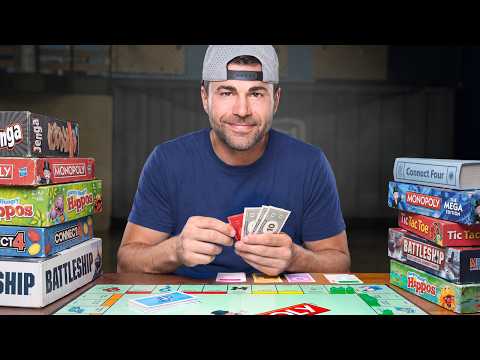
Wholesome yet high-stakes setup: surprising a beloved high school teacher 10 years later with a cinematic board game gauntlet.
Transcript
Going to be honest, Mr. Malloy, I didn't invite you out here today for a tour. This is an ambush. What kind of ambush? A board game ambush. Because 10 years ago, after he statistically solved Guess Who, Mr. Malloy became virtually unbeatable. And using a strategy against him left us deadlocked in tie after tie after tie. So, now, a decade later, I'm not just going for one win, I'm going for a clean sweep six. Behind us are six different board games. It's time for the student to become the teacher. A teacher's proudest moment. Prepare to get your butt kicked.
