
An Urgent Warning For ALL Investors
9 clips from a 15:40 video · top score 95
Get clips like these, freeWhy it works
Personal storytelling about buying $350k homes for $60k during the 2008 crash paired with the hilarious irony of Bloomberg's '100% recession' call happening 5 days into a bull market makes for an elite, shareable investing clip.
Transcript
I will never forget when I started doing real estate in 2008 watching the markets collapse, watching housing prices drop by 26% and remembering that no one wanted to invest. In fact, for a while cash was the best performing asset. But oddly enough, that turned out to be the opportunity because when everyone was into real estate, there wasn't much upside. But when no one wanted to touch it, I was able to get $350,000 homes for $60,000 that today are worth eight times more. And that's what made me realize that the exact moment that no one wants to invest is usually the best time to invest. I also remember back in 2020 when the markets crashed so quickly and everyone was talking like it was going to be the end of the world. But instead, the S&P 500 finished the year at a record price right as I made this video explaining that riches were made in recessions. This also happened again in 2022 where the markets were supposedly over. Jeremy Grantham called it a super bubble and warned that the S&P 500 could fall to around 2500. And that October, Bloomberg Economics put the chance of a recession within 12 months at 100%. Well, wouldn't you know it, that forecast came out on October 17th just five days after the bull market started.
Why it works
Opens immediately with the famous JPMorgan study ($71,000 vs $32,000 by missing just 10 days) and wraps up with a clean 3-rule framework for managing investor emotions.
Transcript
JP Morgan found that if you had invested $10,000 in the S&P 500 from 2005 to 2024, you'd have about $71,000. But, if you missed just the top 10 best trading days, that return falls to $32,000. And seven of those best 10 days occurred during some of the worst days. Plus, if it makes you feel any better, in the decade after the last decade, on average, the stock market triples, which is why it is so important to keep buying and make sure you don't sell. And finally, we have number four, be optimistically cautious. For me, this just comes down to three rules. Size your investments so that you don't get scared off by a drop, treat your emotions almost like a contrarian signal, and then keep buying and ignore the noise with money that you're okay with watching go down in value. Like, my thought here is that usually when everyone's euphoric and excited about something, it's usually not a good time to buy. But when everyone says it's awful and it's going to keep going down and everyone's panicking, usually that's a good buying opportunity.
Why it works
Challenges the universal 'buy the dip' retail mentality with hard historical data showing multi-decade stretches of negative returns, creating immediate urgency and debate in the comments.
Transcript
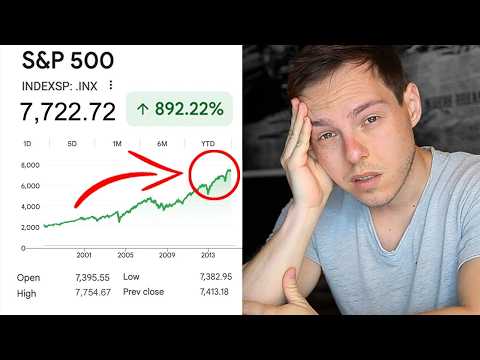
As unpopular as it is to talk about, I'm genuinely concerned for a lot of investors right now because I've noticed so many people have convinced themselves that the stock market is just easy money right now and that every single dip is just another buying opportunity. But, the problem is that eventually there is going to be a downturn that lasts so long that an entire generation of investors is going to start wondering whether or not the market is ever going to come back. And this isn't some crazy hypothetical, either. In fact, most people have completely forgotten that the stock market saw negative returns from 1929 through the 1950s, again from 1966 to 1982, and most recently from 1997 through 2009.
Why it works
Reveals that the 'Lost Decade' only hurt 100% US stock holders while gold 4x'd and bonds doubled, giving viewers high-value, actionable portfolio math they will save and share.
Transcript
So here's what's really interesting about the lost decade. It was only lost if you owned one thing. Like from 2000 to 2009, a dollar in the S&P 500 turned into 90 cents. But US government bonds nearly doubled. A dollar in gold turned into nearly $4. And even a simple mix of 60/40 stocks and bonds finished the decade with a modest gain. That's why to me it is so important that you don't hold all of your eggs in one basket. Starting with number one, own more than US stocks. Remember, the 10 biggest companies now make up about 39% of the entire index. So, just buying the S&P 500 is not nearly as diversified as it used to be. And as a perfect example of this, over the last year, international stocks have returned about 32% compared to roughly 18% for the S&P 500. This was the first time the US was beaten since 2022, which leads us to second, invest in safety. Right now, Treasury bonds are paying some of the highest amounts we've seen in more than 20 years at roughly 5.3%, which is insane. So, it makes sense to have a small portion of your portfolio into something safe so that if the market falls, you have something to fall back on that's also paying you a pretty good yield,
Why it works
Concrete examples like waiting from your late 30s until retirement just to break even, or losing 74% after inflation over 16 years, make abstract market risk feel viscerally real.
Transcript
A lost decade isn't some imaginary, made-up worst-case scenario. It is a real stretch of time where the stock market goes absolutely nowhere for more than 10 years. And as uncomfortable as that might be to talk about, it's already happened in the United States multiple times. Starting with number one, the 1920s Great Depression. When it comes to this, the market peaked in September of 1929 and it took more than 25 years until late 1954 just to get back to that same level. This means if somebody bought at the very top in their late 30s, they had to wait until almost retirement age just for that investment to break even. And oddly enough, we are seeing a lot of articles today about how we're seeing a repeat of the roaring 20s almost exactly 100 years later. By the way, I think that's got to be its own dedicated video because when you get into the similarities between the 1920s and 100 years later today, it's pretty creepy. But, I'll save that for another video because we also got number second, the 1970s. At this point, the Dow hit nearly a thousand in 1966 and then it stalled for 16 years. But, what makes this one so much worse is that inflation nearly tripled prices on everything. So, when you adjust the stock market to inflation, the Dow's real decline for more than a decade was about 74%.
Why it works
Combines a wild institutional statistic from Citadel about retail investor behavior with a sobering reality check on why 'buying the dip' isn't foolproof.
Transcript
Like, according to Citadel Securities, on days when the S&P 500 falls, retail investors have been buying about three and a half times their normal daily amount compared to just 1.4 times on the up days. Even crazier is that in July of this year, there wasn't a single day where retail investors were net sellers on Citadel's platform. Not one. And honestly, why would they? Like, since 2009, the S&P 500 has returned about 14.8% compared to the long-term average of just over 11%. However, as good as that seems, here's the part that almost everybody misses. Buying the dip only works when the stock market recovers. And historically, that doesn't always happen. Sometimes you buy the dip and it keeps falling. And then you wait for years while the market does nothing but go down.
Why it works
Name-dropping major institutions (Vanguard, Goldman Sachs, GMO) with shockingly low 10-year return forecasts immediately sparks debate among everyday S&P 500 investors.
Transcript
Believe it or not, right now, some of the biggest firms in the world are not very optimistic. Like, Vanguard expects US stocks to return just 4 to 5% a year over the next 5 to 10 years. And Goldman Sachs was even more blunt. Like, back in October of 2024, they forecasted just 3% a year for the S&P 500 over the next decade with about a 72% chance that stocks would do worse than Treasury bonds. Of course, to be fair, a year later, Goldman wound up raising their forecast to 6 and 1/2% a year with a range anywhere from 3 to 10%. But, GMO strongly disagrees with this, forecasting that the economy will see -6% real returns for US large caps over the next 7 years.
Why it works
Highlights the recency bias of anyone who started investing in the last 15 years and backs it up with the jaw-dropping stat that a record 33% of all American wealth is currently in stocks.
Transcript
Now, this is the one that people actually call the lost decade because if you invested $10,000 in the S&P 500 on January 1st, 2000, you would have about $9,000 10 years later including dividends. And the Nasdaq did even worse. It took 15 years, 1 month, and 13 days just to get back to its previous high. Now, even though this might sound like unnecessary fear-mongering, I get it. No one likes talking about this stuff when everything's on the up and up and everyone's making money. But, the last time we saw a lost decade was about 20 years ago, which means if you've invested your money at any point over the last 15 years, you've become accustomed to returns that historically are really quite remarkable. Like believe it or not, stocks have never become more popular than they are right now. And at the end of last year, a record 33% of all American wealth was sitting in the stock market. Or basically, at this moment in time, everyone is all in on stocks. Margin debt is at the highest it's been as people leveraged themselves even further into the markets.
Why it works
Delivers the ultimate takeaway of the video in a tight 50-second package, ending on a strong, quotable closing line about surviving a lost decade.
Transcript
I do get worried when I see people going all in on stocks with nothing to fall back on under the assumption that we're going to keep making 10 to 15% a year and those people, I think unfortunately, are going to be in for a very rude awakening. Basically, all of that is to say that right now is a really good time to think about being diversified. I'm talking about investing in not just US stocks, not just the S&P 500, but adding in international allocations, maybe some bonds, maybe a good high-yield savings account, maybe some gold, maybe some real estate exposure, maybe a collectible or two. And that way, if something falls, you have something else to fall back on. And hey, you know what? If the market keeps going up higher, great. But if not, then you won't be forced to sell at the worst possible time because the only way to make it through a lost decade is to make sure you're able to survive it.
